


Okay here we go.
Man the future of telescopes is honestly messing with my head right now.
I’m sitting here in my messy office in the US, January 2026, heat blasting because it’s like 18°F outside, empty energy drink cans everywhere, staring at yet another tab comparing the Extremely Large Telescope (ELT) to the Thirty Meter Telescope (TMT) fight that never ends. My neck hurts from years of craning at eyepieces and I still haven’t forgiven myself for dropping $800 on a 10-inch Dobsonian in 2019 that mostly collects dust because Phoenix light pollution is brutal and I’m too lazy to drive an hour to darker skies.
But dude… the stuff that’s actually coming? It makes that scope feel like a pair of dollar-store binoculars.
Why I’m Obsessed with the Future of Telescopes Right Now Future of Telescopes
Last week I stayed up till 4 a.m. reading the latest papers on adaptive optics upgrades for the ELT. I know, super normal Friday night. My wife found me muttering “deformable mirrors… 5000 actuators…” while the dog was snoring on my feet. I’m not even a real astronomer—just a guy who got way too into astrophotography during the pandemic and never emotionally recovered.
The point is, telescope innovations are moving so fast I genuinely feel FOMO. Like if I blink I’ll miss the generation that actually images continents on exoplanets.
Jersey’s Best
Giant Mirrors on Earth — We’re Going Big and It’s Messy Future of Telescopes
The Extremely Large Telescope (ELT) in Chile is pushing 39 meters. That’s not a typo. When it sees first light (hopefully around 2028-2030 if the funding gods are kind), it’ll collect 13 times more light than the biggest current scopes.
I tried explaining this to my brother over Christmas dinner. He said “cool, so more zoom?” and I almost cried into the mashed potatoes. No, not zoom—light grasp and resolution. We’re talking angular resolution good enough to theoretically read a newspaper headline on the Moon.
Check the official ESO ELT page if you want the pretty renders (they’re gorgeous, I have them as desktop backgrounds).
But here’s the embarrassing part: I used to think bigger mirrors were just flexing. Then I actually tried stacking 30-second exposures on my own mount and watched the stars trail because my tracking is trash. Now I get it. We need those monster mirrors + insane adaptive optics just to fight atmospheric turbulence.
Adaptive Optics on Steroids — The Real Superpower Future of Telescopes
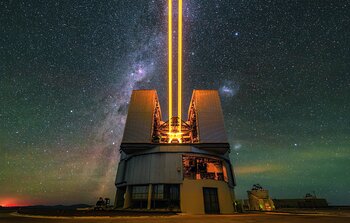
Modern adaptive optics already turn ground-based scopes into almost-space-quality machines. The next jump? Multi-conjugate adaptive optics with laser guide stars on crack.
The Giant Magellan Telescope guys are testing versions that correct turbulence in 3D volumes instead of just one plane. I can’t even visualize it properly but my brain keeps picturing those deformable mirrors rippling like water in slow-mo.
I once tried to collimate my own scope after watching a YouTube tutorial at 1 a.m. Ended up with the mirror 3 mm off and spent the next two hours swearing at a laser pointer. So yeah… I deeply respect anyone who can tune thousands of actuators in real time.
Space Swarms & Interferometry — My Insane 3 a.m. Theory Future of Telescopes
Okay this is where I go full tinfoil hat.
Imagine hundreds of small satellites flying in precise formation, combining their light like a virtual telescope kilometers wide. That’s optical interferometry in space—basically what the Event Horizon Telescope did for black holes but on steroids and actually affordable.
NASA’s LUVOIR and Habitable Worlds Observatory concepts are flirting with this. Also the rumored “Starshade” missions that block starlight so precisely you can see planets directly.
I drew a terrible diagram of this on my iPad last month. It looked like drunk spiders. Still sent it to my group chat. They roasted me. Worth it.
What This Actually Means for Regular People (aka Me) Future of Telescopes
Look, I’m never going to observe with the ELT. But the trickle-down is real.
Cheaper CMOS sensors, better autoguiders, open-source plate-solving software—all that came from pros pushing limits. In ten years my next backyard scope might have real-time atmospheric correction good enough to make my light-polluted suburb feel like Mauna Kea.
I’ll probably still complain about focus drift though. Some things never change.
Picture of the Week | ESO
Final Ramble + Coffee-Fueled Call to Action Future of Telescopes
So yeah. The future of telescopes is stupid exciting and also terrifying because budgets get cut, international politics interfere, and climate change is making ground-based observing sites sweat.
Still… I’m cautiously hyped.
If you’re even a little curious, go outside tonight. Even with a crappy phone camera pointed at Orion you’ll feel it—that itch that maybe, just maybe, the next generation of telescope innovations will let us see something that finally answers the big question: are we alone?
Then come back inside, make terrible coffee, and read more. That’s what I do.
What telescope dreams are keeping you up lately? Drop a comment—I’m nosy.
(also if anyone wants to Venmo me $5 for therapy after I inevitably impulse-buy another eyepiece let me know)